Last March, my wife picked up her pillow, walked down the hall, and closed the guest room door behind her.
She didn't slam it. She didn't say anything. That was almost worse.
We'd shared a bed for 24 years. Through two kids, three moves, one layoff, and her mother's illness. And now she was sleeping forty feet away because of a noise I couldn't hear myself making.
I lay there in the dark that night doing the math on how long it had been since either of us had woken up rested. I couldn't remember.
It didn't start as a problem. It started as a joke.
For years my snoring was the punchline at family gatherings. My brother-in-law did an impression of it at Thanksgiving. Everyone laughed. I laughed.
Then somewhere in my early fifties it stopped being funny.
Karen started nudging me two, three times a night. Then she started going to bed an hour before me so she'd already be asleep. Then came the earplugs. Then the white noise machine. Then the guest room.
And on my end, I was falling apart in slow motion:
-
Waking up with my neck locked so stiff I had to turn my whole body to check the clock
-
That dull ache behind my eyes every single morning before coffee
-
Falling off a cliff at 2:30 every afternoon
-
Waking up with one arm completely numb, shaking it out like a dead fish
-
Flipping the pillow four, five times a night looking for a cool spot that never lasted
I want to be clear about something: I wasn't dying. I wasn't in a hospital. I was just tired in a way that sleep didn't fix anymore. And it was quietly wrecking the best thing in my life.
I tried everything except the obvious thing
Nasal strips. Two different mouth sprays from the pharmacy. Sleeping on my side with a tennis ball sewn into my shirt — yes, really. I bought a wedge from a big-box store that made my lower back hurt within a week.
I even stacked two pillows on top of each other for about a month, because someone on a forum said elevation helps. What it actually did was crank my head forward at an angle that made the neck stiffness worse.
Here's what I never once questioned in all of that: the pillow itself.
I'd owned the same two pillows for somewhere between four and six years. I genuinely couldn't remember buying them. And I'd never thought about them for more than three seconds at a time — because a pillow is the most invisible object in your house. You use it eight hours a night and you never look at it.
What a physical therapist told me over a fence
My neighbor Dan is a retired physical therapist. Thirty-two years in outpatient orthopedics. One Saturday he's watching me try to mow my lawn while holding my neck at a weird angle, and he leans over the fence.
"How old's your pillow?"
I said I had no idea.
He laughed and told me something that reframed the whole thing for me. He said that in three decades of treating necks and shoulders, the single most common thing he saw wasn't injury. It was people spending a third of their life with their head unsupported and their neck bent, and then wondering why their mornings hurt.
He explained it in plain terms. When you lie on your side, there's a gap between your ear and your shoulder. A flat, broken-down pillow doesn't fill that gap — your head tips down toward the mattress, your neck bends sideways, and it stays bent for hours. On your back it's the reverse problem: too much loft pushes your chin toward your chest and crowds everything in your throat.
Research on sleeping posture points the same direction — head and neck position during sleep has a measurable effect on how the airway sits and how much tension builds in the surrounding muscles overnight.
His actual words: "Most people replace their mattress and keep the pillow. It's backwards. The pillow is doing more of the work."
I went inside and looked at mine for the first time in six years. It was a pancake. I could fold it into a taco with one hand.
Karen found it. I made fun of it.
Two weeks later Karen came out of the guest room holding her phone.
"Look at this thing."
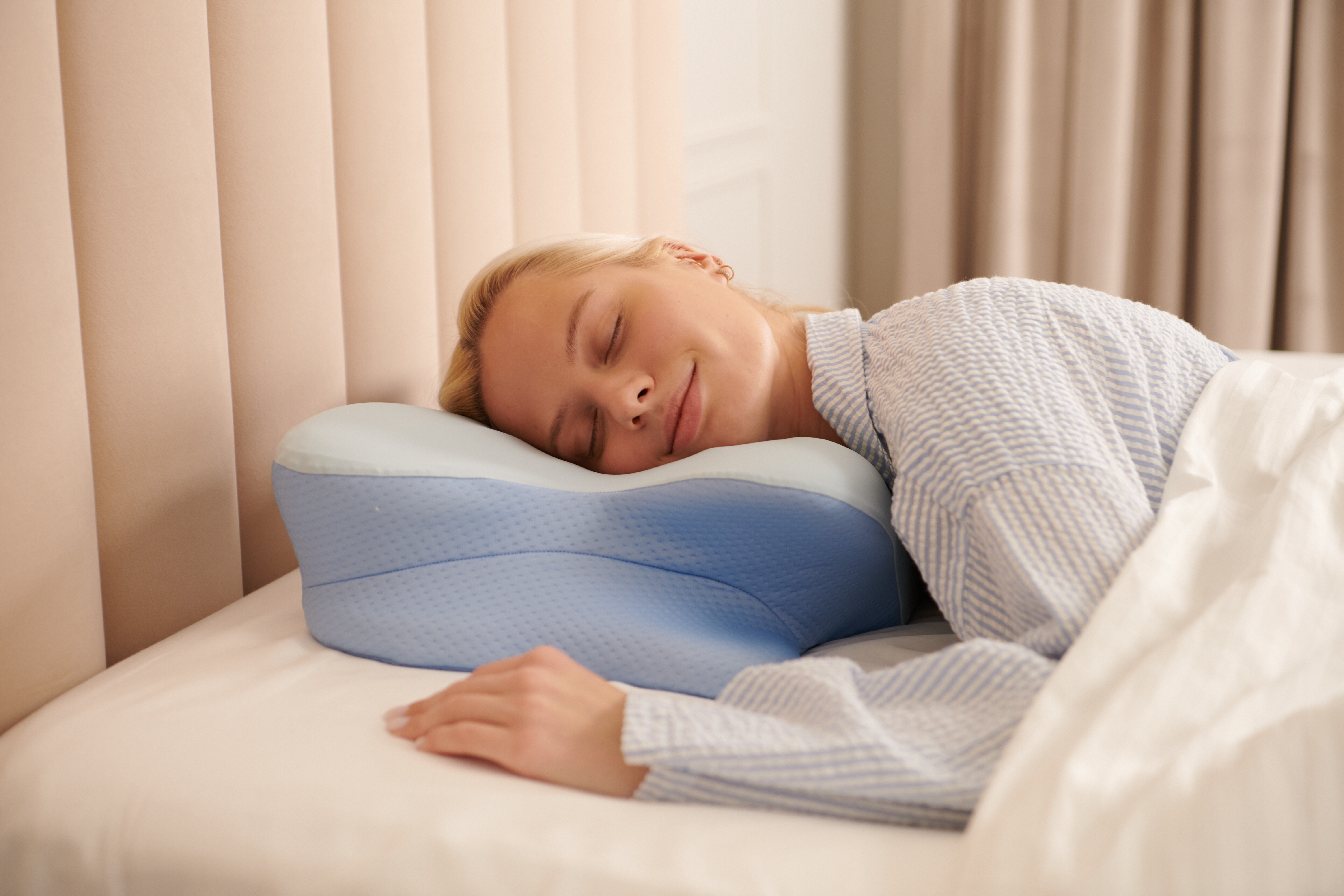
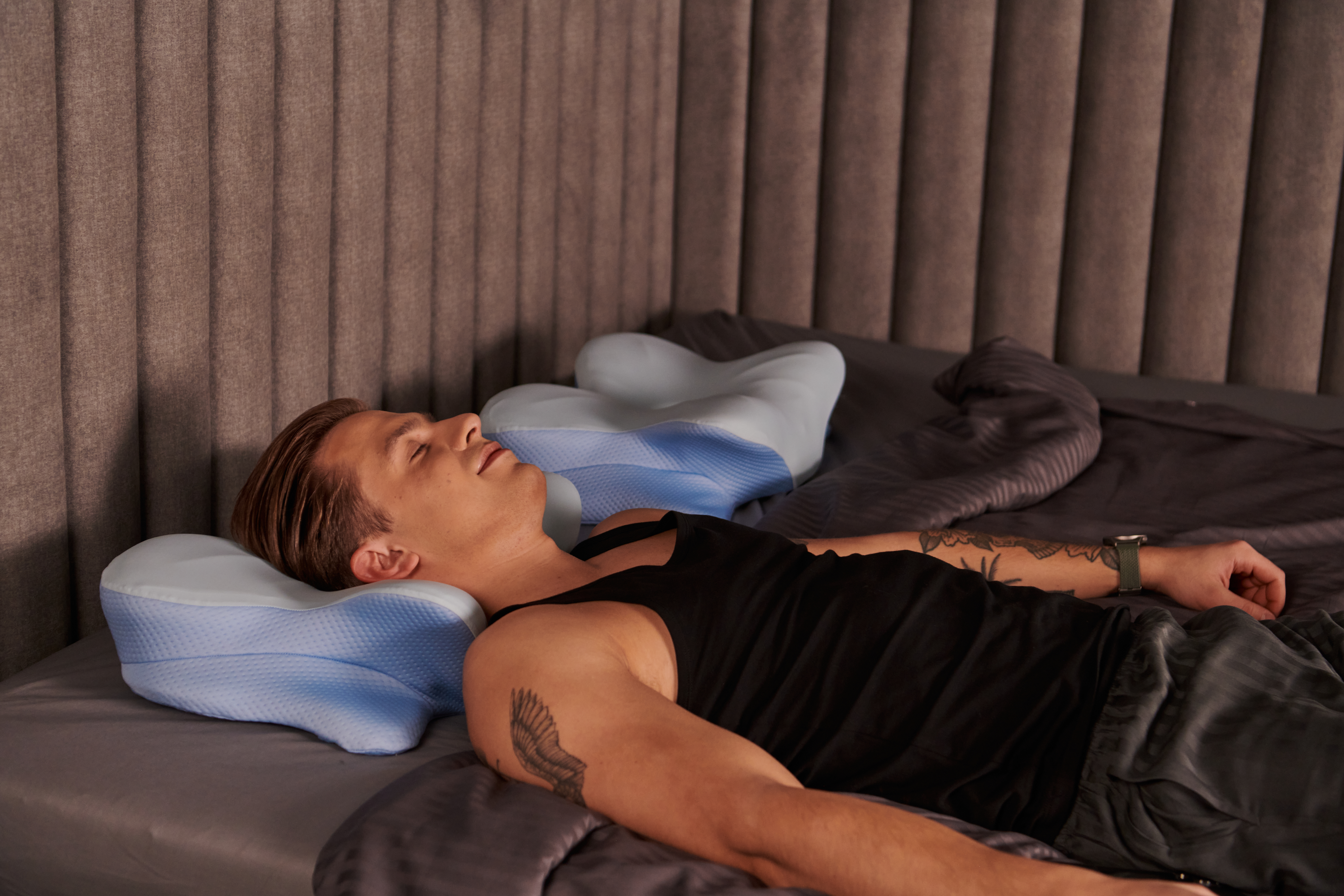
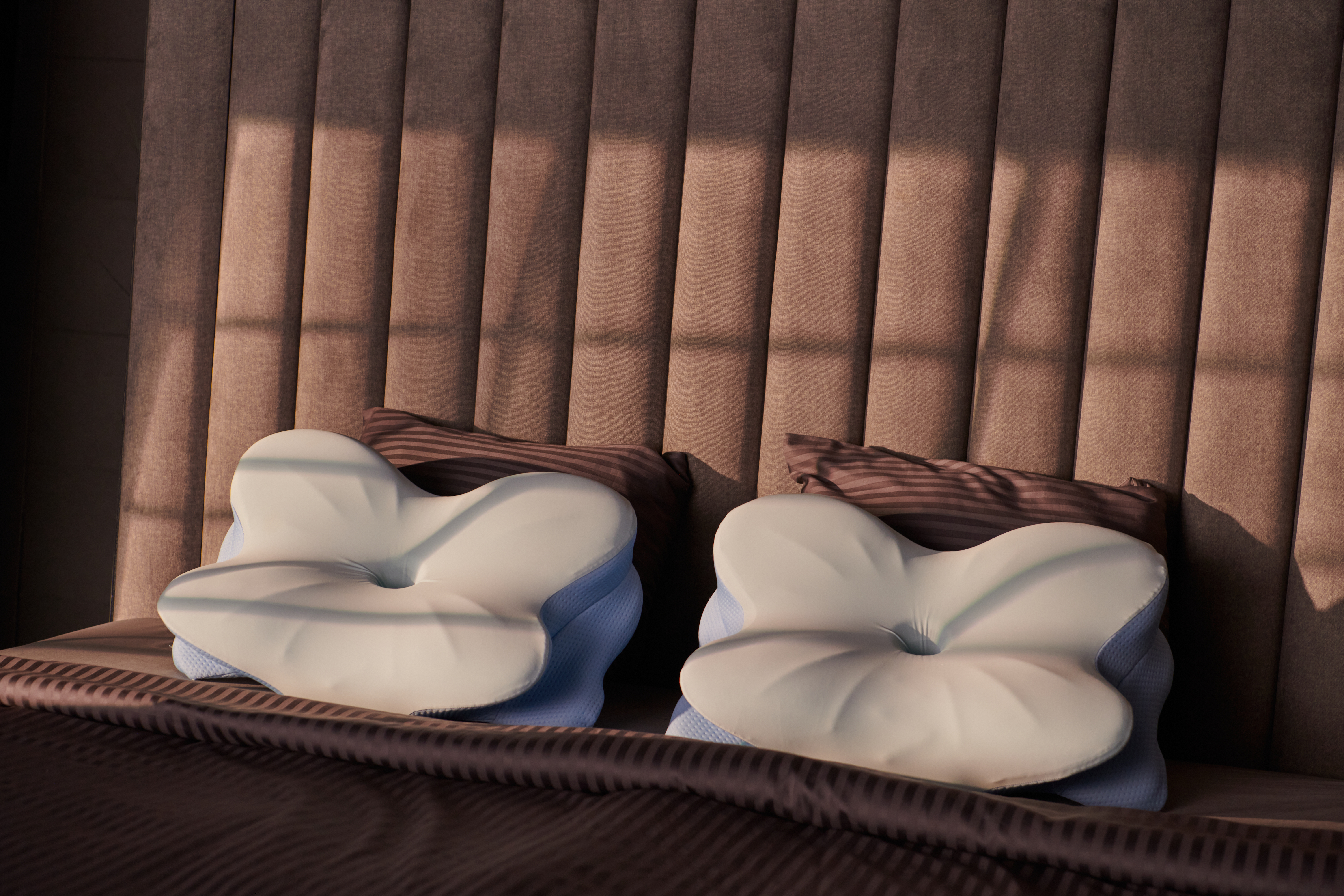
It was the strangest-looking pillow I'd ever seen. It wasn't a rectangle. It had raised sections on both sides, a scooped-out dip in the middle, a curved notch cut out along one edge, and a stepped edge along the bottom.
It looked like a butterfly. I told her it looked like something out of a hospital supply catalog.
It's called the Derila Ergo, and once she explained what each part was actually for, I stopped laughing:
The center cradle — a scooped dip where your head actually sits, instead of a flat surface your head slides off of.
The raised side wings — the higher outer sections that fill that ear-to-shoulder gap when you're on your side, so your neck isn't bent sideways all night.
The neck contour — a raised ridge along the bottom edge that supports the curve of your neck instead of leaving it hanging in midair.
The shoulder cutout — a notch that lets your shoulder tuck underneath the pillow rather than getting jammed up into it. This is the one that fixed my numb-arm mornings.
Memory foam with a breathable structure — it holds its shape instead of compressing to nothing by 1 AM, and it doesn't trap heat the way my old ones did.
The whole design is built around one idea: your head, neck, and shoulders each need something different, so stop trying to solve all three with one flat rectangle.
She ordered two.
The honest version of what happened next
I'm going to tell you this part straight, because I think the overblown versions of these stories are why nobody believes them.
Night one: Strange. Firmer than I expected. My head sat lower and further back than I was used to and I noticed it for about ten minutes. Then I fell asleep. I woke up once instead of my usual four or five times. Neck felt loose. No numb arm.
Night two and three: Better. This is apparently normal — there's an adjustment window while your neck gets used to being supported in a position it hasn't been in for years. Mine was about three nights.
Week one: The morning headache stopped. That's the one I noticed most, because I'd had it so long I'd stopped registering it as a symptom. It was just what mornings felt like.
Week three: Karen came back.
She didn't announce it. She just walked in one night with her pillow, got in on her side, and said "You've been quiet." That was it. That was the whole conversation. I've thought about it probably a hundred times since.
Month two: The 2:30 crash is gone. Not "improved" — gone. I get through the afternoon without the coffee I'd been relying on for years. The neck stiffness comes back occasionally if I fall asleep on the couch, which honestly just proves the point.
I want to say clearly: it's a pillow. It didn't reverse my age or fix my back or make me a different person. Karen still sleeps lighter than I do. What it did was remove a problem I'd been treating as permanent — and it turned out not to be permanent at all. It was just unsupported.
Who this is actually for
Based on what I've read from other people and what Dan told me, the design makes the most sense if you recognize yourself in this list:
-
You sleep on your side or your back (it's built for both; stomach sleepers get less out of it)
-
You stack or fold pillows trying to get the height right
-
You flip the pillow repeatedly looking for a cool spot
-
You wake up with a stiff neck, tight shoulders, or a numb arm
-
Your pillow is more than two years old and has lost its shape
-
You've been told you snore, and you've tried the drugstore aisle without much luck
If none of that sounds like you, this probably isn't the thing you need. But if three or more of those landed — you've likely been sleeping on the wrong support for years without ever suspecting the pillow.
What it costs versus what I'd already spent
I added up what I'd thrown at this problem before Karen found the Ergo. Nasal strips, sprays, the wedge, the white noise machine, two rounds of "premium" pillows from the mall. Comfortably over $300, with nothing to show for it.
A single visit to a sleep specialist runs $200–$300 in most of the country before you've bought a thing. A chiropractor is $70 a session and my insurance covers six.
The Derila Ergo is a fraction of any of those, and there's a 60-night return window — which is the part that made it easy for me. You sleep on it for two months. If your mornings aren't different, you send it back. That's a genuinely low-risk way to test whether your pillow has been the problem all along.
One last thing
The reason I agreed to write this down is that for seven months I thought the guest room was just what our marriage looked like now. Something that happens when you get older. Something you accept.
It wasn't. It was a flattened pillow and six years of not thinking about it.
If you've been lying next to someone who can't sleep because of you — or lying alone in a room down the hall — check the most invisible object in your house before you accept anything.