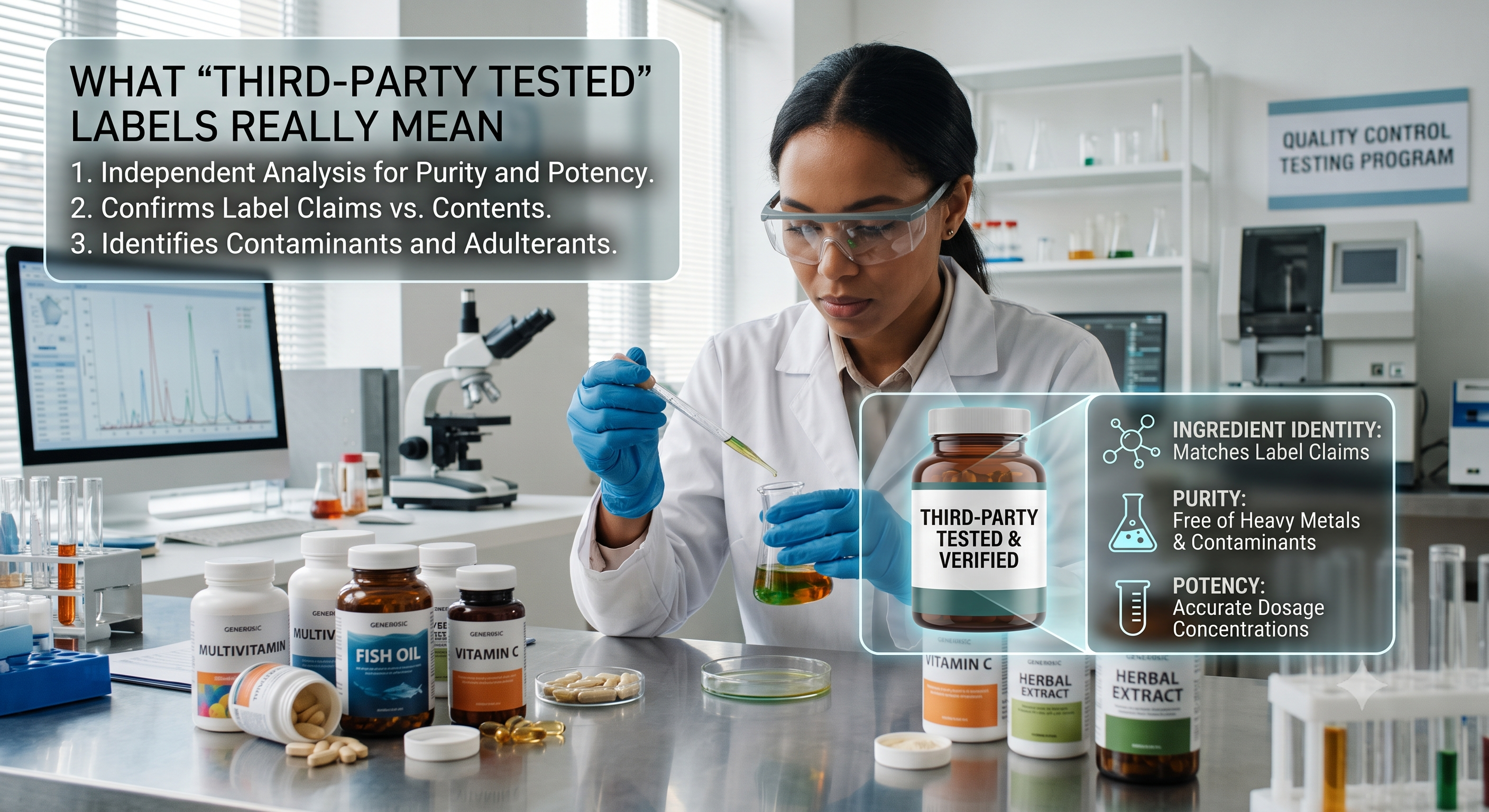
You've probably seen those small certification seals on supplement bottles, USP, NSF, ConsumerLab, and others, and assumed they meant the product was somehow "approved" or guaranteed safe. But most people don't actually know what these certifications verify, what they don't cover, and why they matter so much in an industry that isn't rigorously regulated before products hit the market. Here's a clear breakdown of what these labels really mean.
Why Third-Party Testing Exists in the First Place
Unlike prescription medications, dietary supplements aren't required to be tested and approved by the FDA before they're sold. The FDA regulates supplements more like food than medication, meaning companies are responsible for ensuring safety and accurate labeling themselves, with the FDA only stepping in after a product is already on the market if problems arise.
This regulatory gap is exactly why third-party testing organizations emerged, they provide independent verification that a supplement contains what it claims, in the amounts listed, without harmful contamination.
USP (U.S. Pharmacopeia) Verified
The USP Verified Mark is one of the most respected certifications in the supplement industry.
What it verifies:
-
The product contains the ingredients listed on the label, in the declared amounts
-
The product doesn't contain harmful levels of contaminants like heavy metals, pesticides, or microbes
-
The product will actually break down and release its ingredients properly in the body within a specified time frame
-
The product was manufactured following Good Manufacturing Practices (GMP)
What it doesn't verify: USP certification doesn't confirm the supplement is effective for any specific health benefit, it verifies quality and accuracy, not efficacy.
NSF International Certification
NSF is another widely recognized third-party testing organization, particularly common in sports nutrition products.
What it verifies:
-
Accurate ingredient content matching the label claims
-
Absence of harmful contaminants and undisclosed substances
-
Compliance with manufacturing and quality control standards
NSF Certified for Sport: This is a more specific certification particularly relevant for athletes, verifying the product doesn't contain substances banned by major sports organizations, an important consideration for competitive athletes at risk of contamination-related doping violations.
ConsumerLab Testing
Unlike USP and NSF, which certify products that pay for and pass their testing process, ConsumerLab operates somewhat differently by independently purchasing and testing products, then publishing results, including products that fail to meet claims.
What it verifies:
-
Whether the product contains the labeled ingredients in accurate amounts
-
Absence of contamination
-
Comparison data across multiple brands for the same ingredient
Why this matters: Since ConsumerLab tests products regardless of brand cooperation, it can offer a more independent perspective, including calling out brands that don't meet their own label claims.
Informed Choice / Informed Sport
Similar to NSF Certified for Sport, this certification specifically focuses on verifying that products are free from substances banned in professional sports.
What it verifies: The absence of banned substances that could result in disqualification or sanctions for competitive athletes.
Who this matters most for: Athletes subject to drug testing, since even unintentional contamination with a banned substance can result in serious professional consequences.
What These Certifications Do NOT Guarantee
This is a critical point many people misunderstand: third-party certification does not mean a supplement is effective for its intended health benefit.
These certifications verify:
-
Label accuracy
-
Absence of contamination
-
Manufacturing quality standards
They do not verify:
-
Whether the supplement will actually improve your specific health concern
-
Whether the dosage is clinically effective for the claimed benefit
-
Whether the product is right for your individual health needs
This distinction matters enormously. A perfectly certified, contaminant-free supplement can still be ineffective if it doesn't contain a clinically meaningful dose of an ingredient, or if the ingredient itself isn't well-supported by research for the claimed benefit.
Why So Few Supplements Are Actually Certified
Despite the value these certifications provide, only a relatively small percentage of supplements on the market carry third-party certification. This is largely because certification is voluntary and requires companies to pay for testing, sometimes representing a significant cost, particularly for smaller brands.
What this means for you: The absence of a certification seal doesn't automatically mean a product is low quality, but its presence does provide an added layer of verified assurance that many uncertified products simply can't offer.
How to Find Certified Products
Most certifying organizations maintain searchable databases on their websites where you can verify whether a specific product actually holds a valid, current certification, rather than relying solely on marketing claims or seals printed on packaging.
Quick tip: Always cross-check directly with the certifying organization's website rather than assuming a seal displayed on the bottle or website is automatically valid and current.
Red Flags That Aren't Real Certifications
Be aware that some companies use vague or invented seals designed to look official without representing any genuine third-party testing process.
Watch for:
-
Generic seals with no identifiable certifying organization
-
Claims of being "lab tested" without naming the specific lab or certification body
-
Certifications that can't be independently verified through a search
Does Certification Justify a Higher Price?
Certified products sometimes cost more due to the added expense of the testing process. Whether this premium is worth it depends on your priorities, for higher-risk categories like sports supplements or products for vulnerable populations, certification often represents a worthwhile investment in verified quality and safety.
Putting It All Together: A Quick Certification Checklist
-
Does the product display a recognized certification (USP, NSF, ConsumerLab, Informed Choice)?
-
Can you verify the certification directly through the certifying organization's website?
-
Does the certification align with your specific needs (e.g., Certified for Sport for athletes)?
-
Are you still evaluating the ingredient's actual clinical evidence for your intended benefit, separate from certification?
The Bottom Line
Third-party certification seals provide genuinely valuable, independent verification that a supplement contains what it claims and is free from harmful contamination, something the supplement industry doesn't require by default. However, it's important to understand what these labels do and don't confirm, they verify quality and accuracy, not necessarily effectiveness for your specific health goal. Combining certified products with your own research into ingredient dosages and clinical evidence gives you the most reliable path to choosing supplements that are both safe and genuinely worth your money.